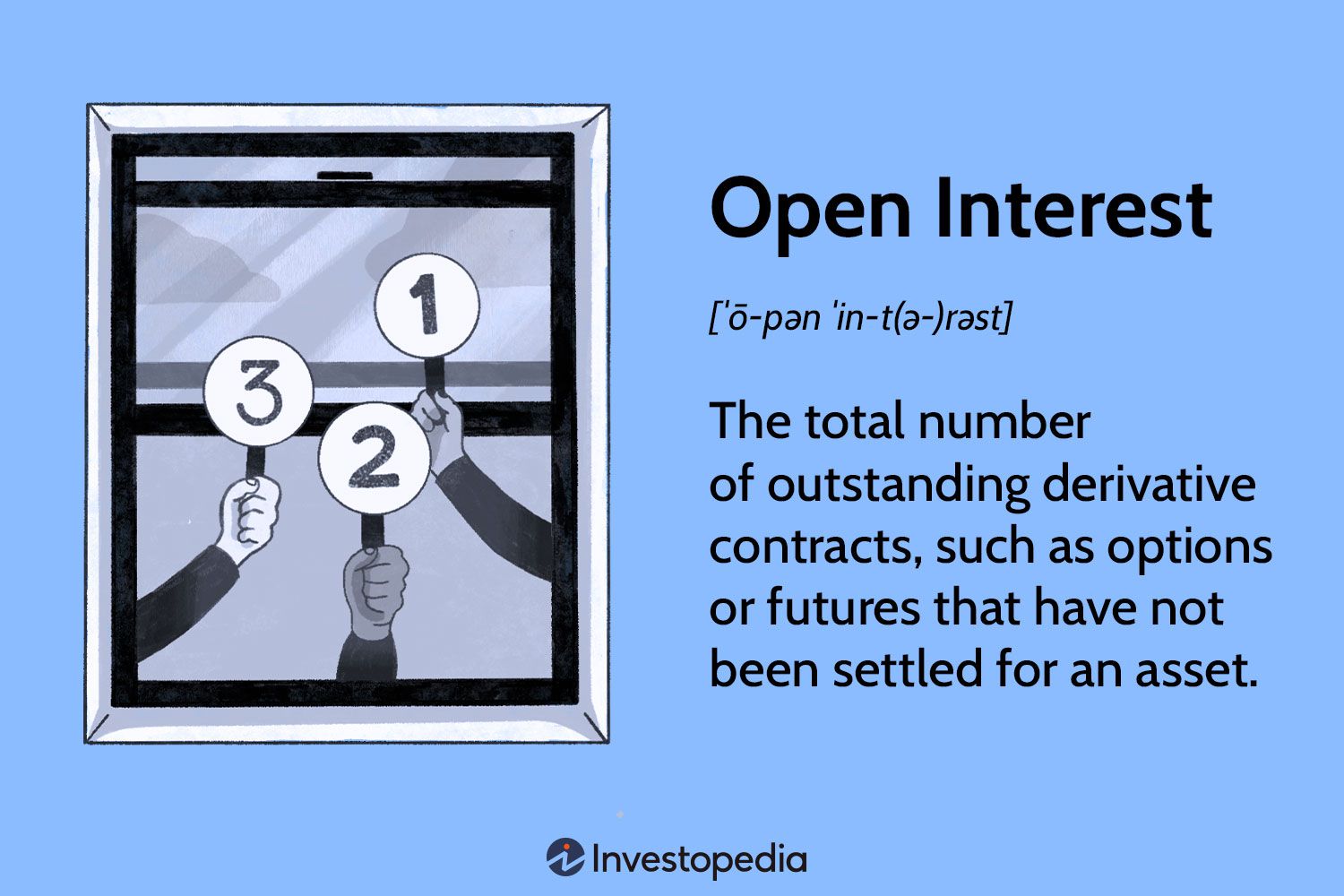
Open Interest
Open interest (also known as open contracts or open commitments) refers to the total number of outstanding derivative contracts that have not been settled (offset by delivery).
For each buyer of a futures contract there must be a seller. From the time the buyer or seller opens the contract until the counterparty closes it, that contract is considered 'open'.
Note, an open contract is not a pending order. A pending order is an instruction to buy or sell a futures contract at a specified price in the future. An open contract is one that has been executed and is currently active in the market.
Open interest also gives key information regarding the liquidity of an option. If there is no open interest for an option, there is no secondary market for that option. When options have large open interest, they have a large number of buyers and sellers. An active secondary market will increase the odds of getting option orders filled at good prices. All other things being equal, the larger the open interest, the easier it will be to trade that option at a reasonable spread between the bid and ask.
As a confirmation indicator
An increase in open interest along with an increase in price is said to confirm an upward trend. Similarly, an increase in open interest along with a decrease in price confirms a downward trend. An increase or decrease in prices while open interest remains flat or declining may indicate a possible trend reversal. The relationship between the prevailing price trend and open interest can be summarized by the following table:
| Price | Open Interest | Interpretation |
|---|---|---|
| Rising | Rising | Market is Strong (Bullish) |
| Rising | Falling | Market is weakening (Bullish reversal) |
| Falling | Rising | Market is weak (Bearish) |
| Falling | Falling | Market is strengthening (Bearish reversal) |
Rising price does not “always” mean an increase in net positions and vice versa. However, for simplicity and application, we used net positioning to represent price and to derive the Interpretation column of our COT table.
Now that you understand open interest, let’s look at how it fits into the COT reports - understanding the COT reports.